Recent industry news suggests that parts of the charging market are entering a new phase.
Reports indicate that TotalEnergies1 is exploring the sale of parts of its German charging business, while BayWa 1 is divesting its charging activities as part of a broader restructuring. These developments raise an important question: is the charging business fundamentally flawed – or is the industry simply evolving?
Most likely, the answer is the latter.
The First Wave: Charging built like Gas Stations
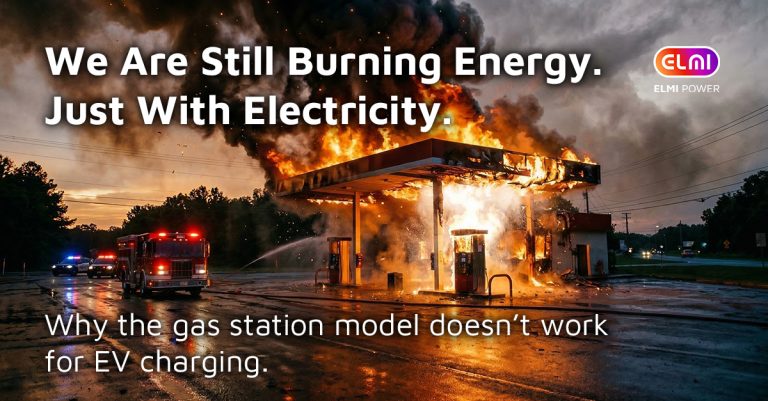
The first phase of the EV charging rollout followed a straightforward model: build infrastructure, connect to the grid and sell electricity per kilowatt hour. In other words, the first wave of charging infrastructure was built like gas stations.
The economics of many public fast-charging sites roughly follow a simple structure. Charging prices in Europe often range around 0.50–0.60 € per kWh, while electricity procurement costs frequently lie between 0.30–0.40 € per kWh. This leaves a gross margin of roughly 0.20 € per kWh.2
From this margin operators still need to cover site leases, maintenance, backend systems, payment infrastructure, operations and the depreciation of chargers and grid connections. After these costs the remaining margin can fall to approximately 0.05–0.10 € per kWh.2
At the same time, the capital intensity of high-power charging infrastructure is significant. Public HPC sites can require investments in the range of 300,000 to 700,000 € per location, depending on grid connection, equipment and construction costs.3
Under these conditions the economic model becomes challenging.
The Structural Challenges: Unit Economics and Grid Constraints
Two structural factors continue to shape the economics of public charging infrastructure: challenging unit economics and constraints in grid access.
As the economics above illustrate, margins per kilowatt hour remain relatively limited once electricity procurement, site leases, operations, maintenance and infrastructure depreciation are taken into account.
At the same time, grid access has become one of the most significant bottlenecks for the expansion of charging infrastructure. High-power charging sites typically require transformer-level connections to the distribution grid. In Germany alone, securing such connections can take 12 to 24 months, depending on local grid capacity and permitting procedures.4
In practice, these constraints are already slowing down the rollout of charging networks. A visible example is the German Deutschlandnetz program: out of roughly 9,000 planned charging points, only around 1,200 have been connected to the grid so far. The program launched at the end of 2023, with the objective of bringing all 9,000 charging points online by the end of 2026.
In some markets the situation is even more constrained. In parts of the Netherlands, grid connection timelines for new power demand can extend to several years — in extreme cases up to a decade.
This illustrates how grid availability — rather than demand or capital — can become the primary limiting factor for scaling charging infrastructure..
Why the Gas Station Model Breaks Down
The core issue is architectural. Early charging networks treated charging infrastructure as stand-alone electricity consumers. But electricity markets behave fundamentally differently from fuel markets.
- Electricity prices fluctuate hourly.
- Grid capacity varies locally.
- Flexibility has economic value.
As a result, purely grid-dependent charging infrastructure faces structural limitations.
The Next Phase: Charging as Energy Platforms
The next generation of charging infrastructure will likely look very different. The next wave of charging infrastructure will not look like gas stations. It will increasingly resemble distributed energy platforms.
The key shift can be summarized simply: charging infrastructure needs to move from grid-dependent infrastructure to grid-flexible energy assets.
This means integrating multiple layers simultaneously, including energy procurement, battery storage, load management, electricity trading, charging infrastructure and software optimization.
Why Batteries Change the Equation
Battery-supported charging systems introduce several structural advantages. First, they can accelerate deployment. By combining lower-voltage grid connections with battery storage, charging infrastructure can often be installed within roughly 3 to 6 months, instead of waiting up to 24 months for large transformer connections.4
Second, batteries enable energy procurement optimisation. European electricity markets regularly show intraday price spreads of approximately 0.05–0.15 € per kWh, depending on market conditions.5 Energy can be purchased when prices are low and stored for later charging demand.
Third, battery systems can generate additional value streams through participation in balancing markets, grid services and electricity trading.
A charging site therefore becomes not only a mobility infrastructure asset but also an energy asset.
The Bigger Shift: AI Driven System Optimization
However, the transformation goes further than infrastructure optimization alone. Charging infrastructure is increasingly becoming part of a broader energy ecosystem that includes renewable generation, energy storage, electricity markets and digital optimization.
This is where the ELMI-concept of AI-driven sector coupling for electrified transportation becomes relevant. Instead of optimizing infrastructure alone, the focus shifts to optimizing the entire system: energy purchase, energy storage, energy trading, grid interaction and charging demand.
A New Phase for the Charging Industry
The developments currently visible in the market may therefore reflect a broader transition. The first phase of the industry was defined by infrastructure rollout. The next phase will increasingly focus on energy system optimization.
Charging infrastructure will evolve from isolated charging points into intelligent nodes within a flexible, data-driven energy system. And that transformation will ultimately determine how scalable and profitable the electrification of transportation becomes.
Source:
- Electrive – “TotalEnergies and BayWa put German charging businesses up for sale”, March 2026
European public charging price benchmarks (Ionity, Fastned, EnBW pricing ranges and market analyses)
- Industry estimates for high-power charging infrastructure investment costs (IEA, Transport Environment)
- Grid connection timelines and infrastructure challenges for EV charging deployment
- European wholesale electricity market data (day-ahead and intraday price spreads – EPEX Spot and Ember-Climate)